API Key Authentication vs. OAuth: Which Approach Fits Your Banking Project?

James Whitfield
16 June 2026
API Key Authentication vs. OAuth: Which Approach Fits Your Banking Project?
Choosing the right authentication method for a banking integration isn’t just a technical decision — it’s a strategic one that affects security posture, regulatory compliance, developer experience, and long-term scalability. Get it wrong, and you could face costly refactors, audit failures, or worse, a data breach that erodes customer trust.
In this comprehensive guide, we’ll break down the two most common authentication paradigms — API key authentication and OAuth token-based flows — and examine how each one fits into the unique demands of banking and financial services projects.
Understanding the Fundamentals
Before diving into comparisons, let’s establish a clear understanding of what each approach entails.
What Is API Key Authentication?
API key authentication is one of the simplest forms of securing an API. A unique string (the API key) is generated by the server and shared with the client. The client includes this key in every request — typically as a header, query parameter, or part of the request body — to prove its identity.
“`
GET /api/v1/accounts
Host: bank-api.example.com
X-API-Key: skliveabc123def456ghi789
“`
The server validates the key against its records and either grants or denies access. It’s straightforward, easy to implement, and widely understood.
What Is OAuth?
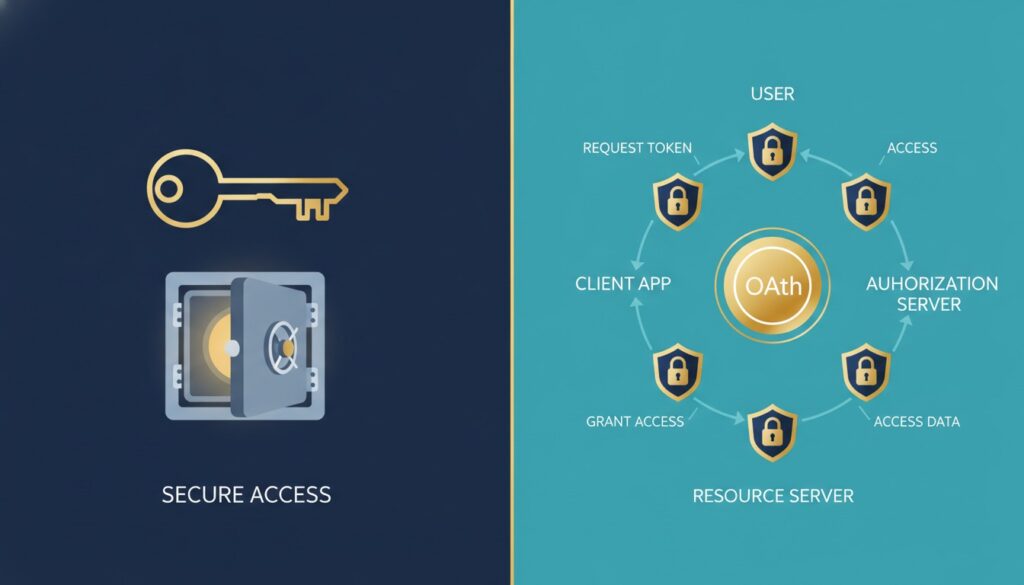
OAuth (specifically OAuth 2.0) is an authorization framework that enables third-party applications to obtain limited access to a service on behalf of a resource owner. Rather than sharing credentials directly, OAuth uses a series of token exchanges:
- The client requests authorization from the resource owner.
- The authorization server issues an access token (and often a refresh token).
- The client uses the access token to access protected resources.
- When the access token expires, the refresh token can be used to obtain a new one.
Key distinction: API keys authenticate the application, while OAuth can authenticate and authorize both the application and the user acting on behalf of the application.
Security Considerations for Banking
Security is non-negotiable in banking. Let’s examine how each approach stacks up.
API Key Security Profile
Strengths:
- Simple to implement and audit
- Easy to rotate and revoke
- Low overhead for server-to-server communication
- Works well behind firewalls and VPNs where the transport layer is already secured
Weaknesses:
- API keys are long-lived secrets — if compromised, they grant access until manually revoked
- No built-in concept of scopes or permissions (you must build this yourself)
- Keys are often accidentally committed to version control, logged in plaintext, or shared insecurely
- No native support for user-level delegation
- Difficult to implement fine-grained access control without additional layers
OAuth Security Profile
Strengths:
- Access tokens are short-lived, limiting the window of exploitation
- Built-in support for scopes and granular permissions (e.g., `read:accounts`, `write:transfers`)
- Supports the principle of least privilege natively
- Enables delegated authorization without sharing credentials
- Refresh token rotation provides an additional security layer
- Well-defined standards for token revocation and introspection
Weaknesses:
- More complex to implement correctly
- Misconfiguration can introduce vulnerabilities (e.g., open redirects, token leakage)
- Requires careful management of token storage on the client side
- The authorization server itself becomes a critical security component
Banking takeaway: For any scenario involving customer-facing applications, third-party integrations, or open banking APIs, OAuth’s short-lived tokens and granular scopes provide a significantly stronger security posture. API keys may suffice for internal, server-to-server communication within a trusted network.
Compliance and Regulatory Alignment
Banking projects operate under strict regulatory frameworks — PSD2, GDPR, SOC 2, PCI DSS, and various national regulations. Your authentication choice has direct compliance implications.
PSD2 and Open Banking
The Revised Payment Services Directive (PSD2) in Europe mandates that banks provide third-party providers (TPPs) with access to customer account data and payment initiation services. The standard explicitly requires:
- Strong Customer Authentication (SCA) — multi-factor authentication for customer-initiated actions
- Consent-based access — customers must explicitly grant permission
- Token-based authorization — the Berlin Group’s NextGenPSD2 and the UK’s Open Banking Standard both prescribe OAuth 2.0 flows
PCI DSS Considerations
Under PCI DSS, any system handling cardholder data must implement robust access controls:
- Requirement 7: Restrict access to cardholder data by business need-to-know
- Requirement 8: Identify and authenticate access to system components
- Requirement 10: Track and monitor all access
GDPR and Data Minimization
OAuth scopes naturally support data minimization — a core GDPR principle. You can issue tokens that only grant access to the specific data categories the user has consented to share. With API keys, you’d need to build this permission layer from scratch.
| Requirement | API Keys | OAuth 2.0 |
|—|—|—|
| Strong Customer Authentication | ❌ Not supported | ✅ Supported via OIDC/SCA |
| Delegated Authorization | ❌ Not supported | ✅ Native support |
| Granular Scopes | ⚠️ Custom implementation | ✅ Built-in |
| Token Expiration | ❌ Long-lived by default | ✅ Short-lived tokens |
| Audit Trail | ⚠️ Requires custom logging | ✅ Token introspection |
| PSD2 Compliance | ❌ Insufficient | ✅ Prescribed standard |
Use Case Analysis: When to Use Each Approach
The right choice depends heavily on your specific use case. Here’s a detailed breakdown.
When API Keys Make Sense
1. Internal Microservice Communication
When services within your banking platform communicate behind a firewall or service mesh, API keys combined with mutual TLS (mTLS) provide a lightweight, high-performance authentication mechanism.
“`
Internal service call with API key + mTLS
curl –cert client.pem –key client-key.pem \
-H “X-API-Key: internalsvckey_abc123″ \
https://internal-ledger-service:8443/api/v1/balances
“`
2. Webhook Delivery Verification
When your banking platform sends webhooks to partner systems (e.g., transaction notifications), a shared API key or HMAC signature provides simple, effective verification.
3. Rate Limiting and Usage Tracking
API keys excel as identifiers for tracking usage, enforcing rate limits, and billing partners — even when used alongside OAuth for actual authorization.
4. Developer Sandbox Environments
For sandbox or testing environments where security requirements are relaxed, API keys reduce friction for developers exploring your API.
When OAuth Is Essential
1. Customer-Facing Applications
Mobile banking apps, web portals, and any application where an end user logs in and accesses their own financial data must use OAuth (typically with OpenID Connect for authentication).
2. Third-Party Integrations (Open Banking)
When fintech partners, account aggregators, or payment initiators need access to customer accounts, OAuth’s consent-based delegation model is not just best practice — it’s often legally required.
3. Multi-Tenant Platforms
If your banking API serves multiple institutions or partners with different permission levels, OAuth’s scope and audience mechanisms provide clean, standards-based access segregation.
4. Cross-Organization API Access
When external organizations need to access your APIs, OAuth’s Client Credentials flow provides secure machine-to-machine authentication with automatic token expiration — far safer than sharing long-lived API keys across organizational boundaries.
Implementation Best Practices for Banking Projects
Regardless of which approach you choose, follow these best practices to maximize security and maintainability.
If You Choose API Keys
- Never transmit keys in URLs — use headers exclusively to prevent keys from appearing in server logs and browser history
- Implement key rotation policies — enforce regular rotation (e.g., every 90 days) and support multiple active keys during transition periods
- Add IP allowlisting — restrict API key usage to known IP addresses or CIDR ranges
- Layer additional security — combine API keys with mTLS, HMAC signatures, or request signing for defense in depth
- Monitor and alert — implement real-time monitoring for unusual usage patterns and automated alerting for potential key compromise
- Use separate keys per environment — never share keys between development, staging, and production
If You Choose OAuth
- Use the right grant type — Authorization Code with PKCE for public clients, Client Credentials for machine-to-machine
- Keep access token lifetimes short — 5-15 minutes is typical for banking applications
- Implement refresh token rotation — issue a new refresh token with each use and invalidate the old one
- Define granular scopes — map scopes to specific business capabilities (e.g., `accounts:read`, `payments:initiate`, `statements:download`)
- Validate tokens properly — use token introspection or local JWT validation with proper signature verification, audience checks, and expiration validation
- Secure your authorization server — this is your most critical infrastructure component; treat it accordingly
Pro tip: Many mature banking platforms use a hybrid approach — OAuth for external and customer-facing access, API keys for internal service communication, and both working together for partner integrations where API keys handle identification/rate limiting while OAuth handles authorization.
The Hybrid Approach: Best of Both Worlds
In practice, most successful banking platforms don’t choose one approach exclusively. Instead, they implement a layered authentication architecture:
“`
┌─────────────────────────────────────────────┐
│ External Clients (OAuth) │
│ Mobile Apps, Web Apps, Third-Party TPPs │
├─────────────────────────────────────────────┤
│ API Gateway Layer │
│ API Key (identification + rate limiting) │
│ OAuth Token (authorization + scopes) │
├─────────────────────────────────────────────┤
│ Internal Services (API Key + mTLS) │
│ Microservices, Batch Processors, Queues │
└─────────────────────────────────────────────┘
“`
This architecture provides:
- Defense in depth — multiple authentication layers
- Flexibility — different security levels for different trust boundaries
- Compliance — OAuth satisfies regulatory requirements at the external boundary
- Performance — lightweight API key validation for internal high-throughput communication
- Observability — API keys enable partner-level tracking while OAuth tokens enable user-level auditing
Making Your Decision: A Practical Framework
Ask yourself these five questions to guide your decision:
- Does a human user need to grant consent? → OAuth is required
- Are you subject to PSD2 or open banking regulations? → OAuth is required
- Is this purely server-to-server within a trusted network? → API keys may suffice
- Do you need granular, per-user permissions? → OAuth is strongly recommended
- Is this a sandbox or development environment? → API keys reduce friction
Conclusion
The choice between API key authentication and OAuth in banking isn’t truly an either/or decision. API keys offer simplicity and performance for internal and low-risk scenarios, while OAuth provides the security, compliance, and delegation capabilities that modern banking demands.
For most banking projects, the answer is a thoughtful combination of both — using each approach where it provides the most value while maintaining a coherent, auditable security architecture.
The financial services industry is moving decisively toward OAuth-based standards for external APIs, driven by regulations like PSD2 and the growing open banking ecosystem. If you’re starting a new banking project today, build your external API security on OAuth 2.0 from day one — retrofitting it later is significantly more expensive and risky.
Ready to Architect Your Banking API Security?
Don’t leave your authentication architecture to chance. Start by mapping your integration points, identifying your trust boundaries, and matching each one to the appropriate authentication mechanism. If you’re navigating PSD2 compliance or building an open banking platform, invest in a robust OAuth implementation early — your future self (and your compliance team) will thank you.
Have questions about implementing authentication for your banking project? Share your challenges in the comments below, or reach out to discuss your specific architecture needs. And if you found this guide valuable, subscribe to our newsletter for more in-depth technical comparisons tailored to financial services engineering.